

Following the Maharashtra government's new Government Resolution (GR) dated August 3, a fresh controversy has arisen regarding the permission granted to BHMS doctors to practice allopathy, or modern medicine. Numerous MBBS doctors and medical associations have opposed the decision to authorise BHMS doctors who have completed the Certificate Course in Modern Pharmacology (CCMP) to practice in this manner.
Their primary concern is not directed against homoeopathy itself, but rather questions whether a single short-term certificate course can provide clinical training equivalent to that of an MBBS degree for practising modern medicine. The issue has now sparked a significant debate concerning medical education, patient safety, and the boundaries between different medical systems.
On August 3, the Medical Education Department of the Maharashtra government issued a new Government Resolution. This resolution paved the way for BHMS graduates who have completed the CCMP course to register to practice modern medicine. The Maharashtra Medical Council (MMC) was authorised to resume the process of granting conditional registration to eligible CCMP-BHMS practitioners.
Following this decision, objections from doctors practising modern medicine intensified. Various medical associations, including the Indian Medical Association, have demanded a reconsideration of the decision. They argue that such a decision should not have been taken while the matter is sub judice.
A key argument raised by MBBS doctors in this debate concerns the disparity in clinical training. In a report published by "The Quint", an MBBS doctor explained that while BHMS training centres on homoeopathy, the MBBS curriculum involves extensive clinical training alongside foundational subjects such as anatomy, physiology, biochemistry, and pathology geared towards modern medicine. In his view, a one-year CCMP course cannot serve as a replacement for such rigorous, long-term training.
In essence, the objection is not about whether the homoeopathic system of medicine is good or bad; rather, the core issue is that a doctor must possess adequate training in the diagnosis and treatment protocols of the specific medical system they practice.
Another major issue in this debate concerns "cross-practice." Opposing physicians have raised questions about whether, if BHMS doctors are permitted to use modern medicine, similar measures might subsequently be introduced for other medical systems such as Ayurveda or Unani.
Their argument is that each medical system has its own distinct syllabus, textbooks, and treatment approach. Therefore, if a physician wishes to practice a system other than their primary one, adequate training and a specific regulatory framework are essential.
The issue here is not about who provides better treatment; rather, the core question is what kind of training a physician has received to administer a particular type of treatment.
Following the release of the GR, MBBS doctors and various medical associations launched protests. Their concerns centred on patient safety and training standards for modern medical practice.
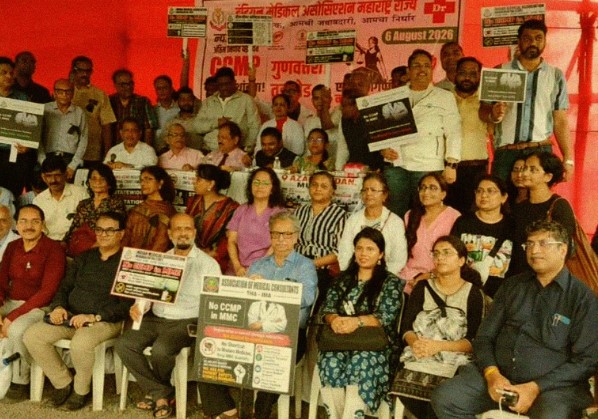
Doctors also staged a protest at Azad Maidan in Mumbai on August 6. At the same time, various medical associations called for agitations and work stoppages.
However, reports indicate that the medical associations later withdrew their strike and returned to work following the help of the Bombay High Court. At the same time, they announced their intention to continue their legal and policy-based battle regarding cross-practice.


Comments ( 0)
Leave a Comment
No comments yet. Be the first to comment!