

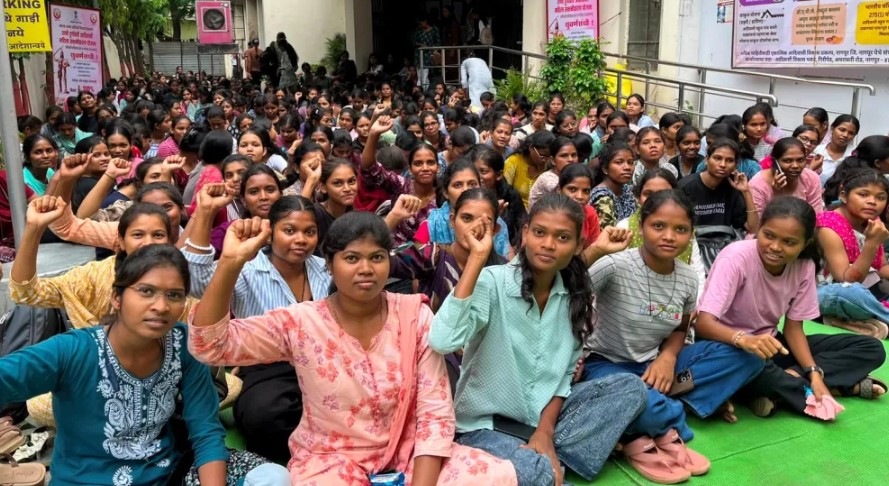
Maharashtra's public school education system is currently grappling with a multitude of challenges. In some areas, there is a shortage of teachers; in others, existing electricity or internet connections are non-functional; and elsewhere, there is a lack of essential facilities such as toilets, drinking water, computers, or infrastructure for students with disabilities.
Additionally, plans to merge schools with low enrollment into clusters or other institutions, alongside the declining number of Marathi-medium schools, have sparked fresh concerns. This is no longer an issue confined to a few isolated schools; questions are now being raised about the overall capacity of the public education system itself.
Viewing Maharashtra's education crisis merely as a matter of "schools closing" or a "shortage of teachers" fails to capture the full picture. Issues such as teacher shortages, poor infrastructure, the future of schools with low enrollment, the state of tribal hostels and 'ashramshalas' (residential schools for tribal students), the deployment of teachers for non-academic tasks, and the declining number of Marathi-medium schools are all interconnected.
State government data for the 2025-26 academic year indicates that Maharashtra has 1,08,139 schools, approximately 2 cr 16 lakh students, and 7,50,272 teachers. However, the same data reveals that 3,201 schools have no electricity connection at all, while another 10,938 schools have connections that are non-functional. Additionally, 23,855 schools lack internet connectivity.
The situation regarding computer facilities is also far from ideal. Although 90,419 schools were supposed to have computer facilities, functional computers were available in only 84,530 schools; this means that 23,609 schools lacked functional computer systems. These statistics are particularly significant at a time when there is increasing emphasis on digital education, coding, and AI-based learning.
In August 2026, a protest by tribal students took various issues within the government residential education system to the forefront. Several students had staged a hunger strike at the Government Boys' Hostel in the Hadapsar-Manjari area of Pune.
A Government Resolution issued on August 14 had set an upper age limit of 30 years for admission to tribal hostels, which was one of the immediate triggers for the protest. However, the students' list of demands also included issues such as hostel security, food quality, sanitation, medical care, and staff shortages.
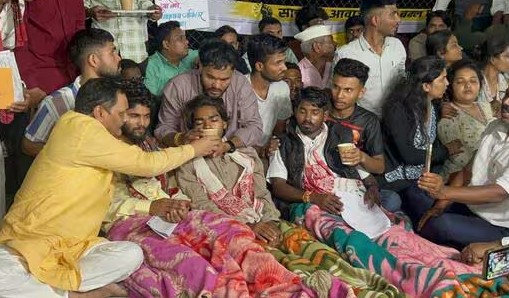
On August 25, Tribal Development Minister Ashok Uike announced that the 30-year age limit for admission to tribal hostels had been withdraw; effectively, the government conceded on a key demand. Reports indicate, however, that the protest had already continued for 13 days before this decision. This raises a significant question: must students repeatedly use to protests or hunger strikes just to resolve a single issue?
Among the controversies surrounding Marathi-medium schools, a remark by Supreme Court Justice P.B. Varale has also drawn attention. Citing a ''Times of India'' report, SabrangIndia stated that during an event in Nashik on August 22, he questioned the state's priorities regarding education spending.
According to the report, Justice Varale asked whether a small fraction of the massive funds proposed for the Nashik Simhastha Kumbh Mela could have been utilised for the education sector. The report notes his observation that allocating just 0.1 per cent, approximately ₹32 crore, could potentially prevent the closure of 100 to 150 Marathi-medium schools.
The Maharashtra government has informed the Union government that a comprehensive development plan worth ₹22,425.39 crore has been approved for the 2027 Nashik Simhastha Kumbh Mela. This plan received approval during a meeting of the Apex Committee, led by the Chief Minister, on March 13, 2026.
The report further states that Justice Varale expressed concern regarding the conditions of residential schools and 'Ashramshalas'. Mentioning the deaths of 3 tribal girls due to snakebites, he raised questions about the overall state of affairs in certain residential schools.
However, Justice Varale's statements should be viewed as observations; they form part of a broader policy debate concerning priorities within the education budget.
Comments ( 0)
Leave a Comment
No comments yet. Be the first to comment!