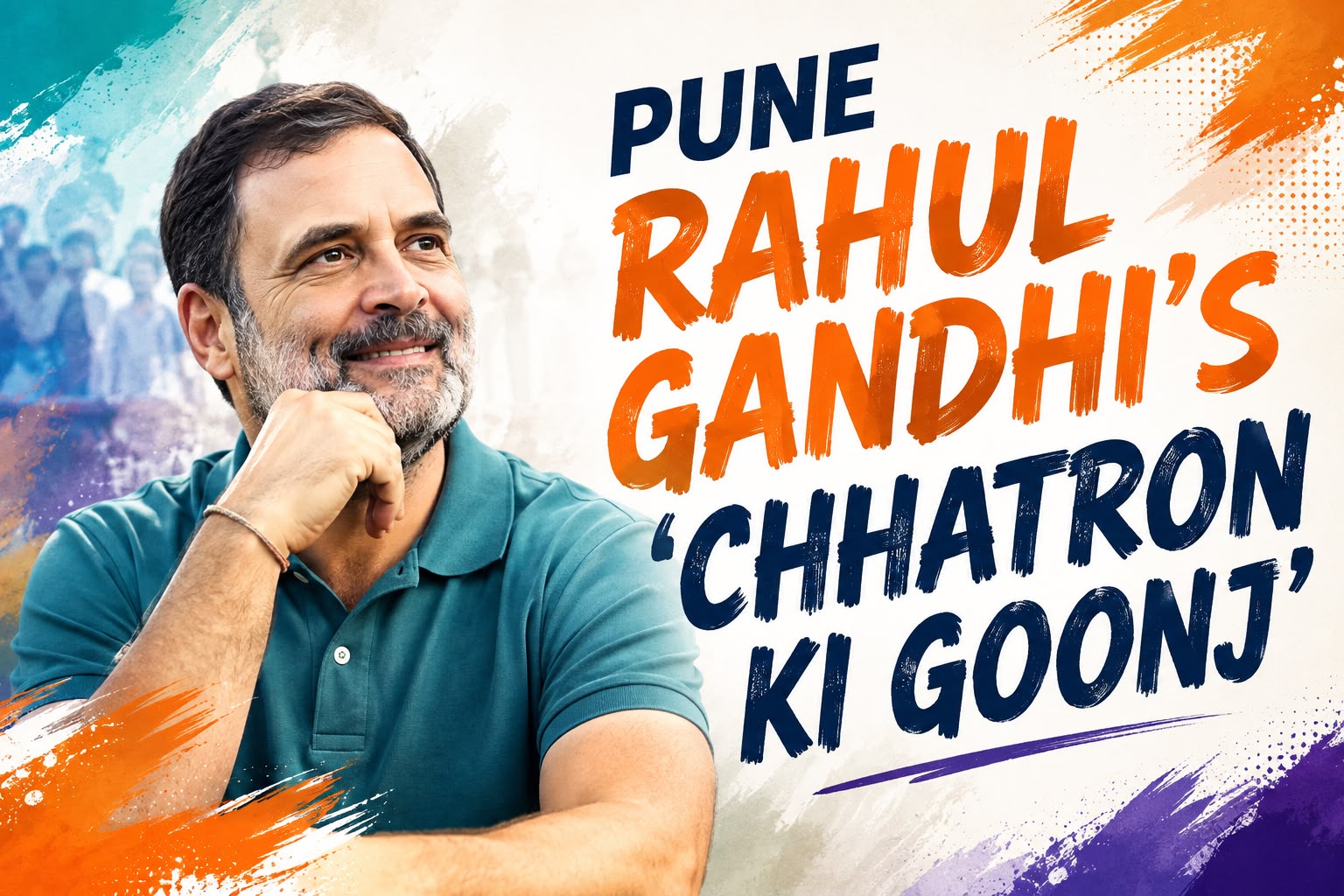
PUNE, August 22, 2026: Congress leader and Leader of Opposition in the Lok Sabha Rahul Gandhi interacted with women students in Pune on Saturday during the fourth edition of the ‘Chhatron Ki Goonj’ programme, where education, competitive examinations, paper leaks, employment, women’s safety and social equality emerged as key issues.
The programme, organised as part of Gandhi’s student outreach initiative, was held at the AISSMS College Ground in Pune. Unlike earlier editions, the Pune programme was focused exclusively on young women students.
Gandhi listened to students describing difficulties faced during competitive examinations and concerns about their future. Among the issues raised was the alleged paper leak in an MPSC Drug Inspector examination. A Pune student, Sharayu Chopade, reportedly spoke about the impact of the controversy on candidates who had spent considerable time preparing for the examination.
The student’s concern centred on a question that has become increasingly important for competitive-examination aspirants: what happens to students who prepare for years when an examination is affected by alleged irregularities?
Gandhi listened to the student’s account and assured her that the concerns raised by students would be taken up. He also used the interaction to highlight what he described as wider problems relating to examination systems, education and opportunities for young people.
Women’s safety and independence formed another major part of the interaction.
In his address, Gandhi spoke about the social expectations placed on women and questioned the idea that a woman’s identity should be determined by her relationship with her father, husband or son. He argued that women should have the freedom to decide the direction of their own lives.
Gandhi described India’s women as one of the country’s biggest assets and said their aspirations, abilities and participation were essential to the country’s future.
The discussion also touched upon harassment, discrimination and the difficulties faced by women who speak openly on public issues. Gandhi referred to the broader social environment in which women can face criticism and abuse for expressing their views.
Education and employment remained closely connected to the discussion. Students raised concerns about the quality of education, competitive examinations and the uncertainty surrounding their careers. For many young people, the issue is not simply obtaining an educational qualification but securing a fair opportunity to compete and build a career.
Gandhi sought to connect these concerns with his larger argument that young people, particularly women, should have greater freedom and opportunities.
The Pune programme also generated political controversy outside the student interaction. Police permission for the event reportedly came with several conditions concerning security, banners, images and the conduct of the gathering. Political tensions were also reported around educational institutions in the city ahead of the programme.
The event subsequently became a subject of political criticism, with opposition parties questioning the Congress programme while Congress leaders defended it as an effort to establish direct communication between students and the Leader of Opposition.
For the students who participated, however, the central issues were more immediate — examination fairness, education, employment, safety and the freedom to make decisions about their own lives.
The Pune edition of ‘Chhatron Ki Goonj’ consequently became more than a conventional political address. It provided a platform where student concerns were placed directly before a senior national political leader, while Gandhi used the occasion to present his views on women’s equality, education, examination systems and the future of India’s youth.
Importantly, the precise wording of every student question and every response made during the interaction has not been publicly released in full. Therefore, the reported exchanges should be understood as a journalistic reconstruction based on publicly reported details rather than a verbatim transcript.
The underlying message of the Pune interaction was clear: students want a fair education and examination system, better career opportunities and a safer environment, while Gandhi sought to position women’s independence and equality at the centre of his political engagement with young India.
Comments ( 0)
Leave a Comment
No comments yet. Be the first to comment!