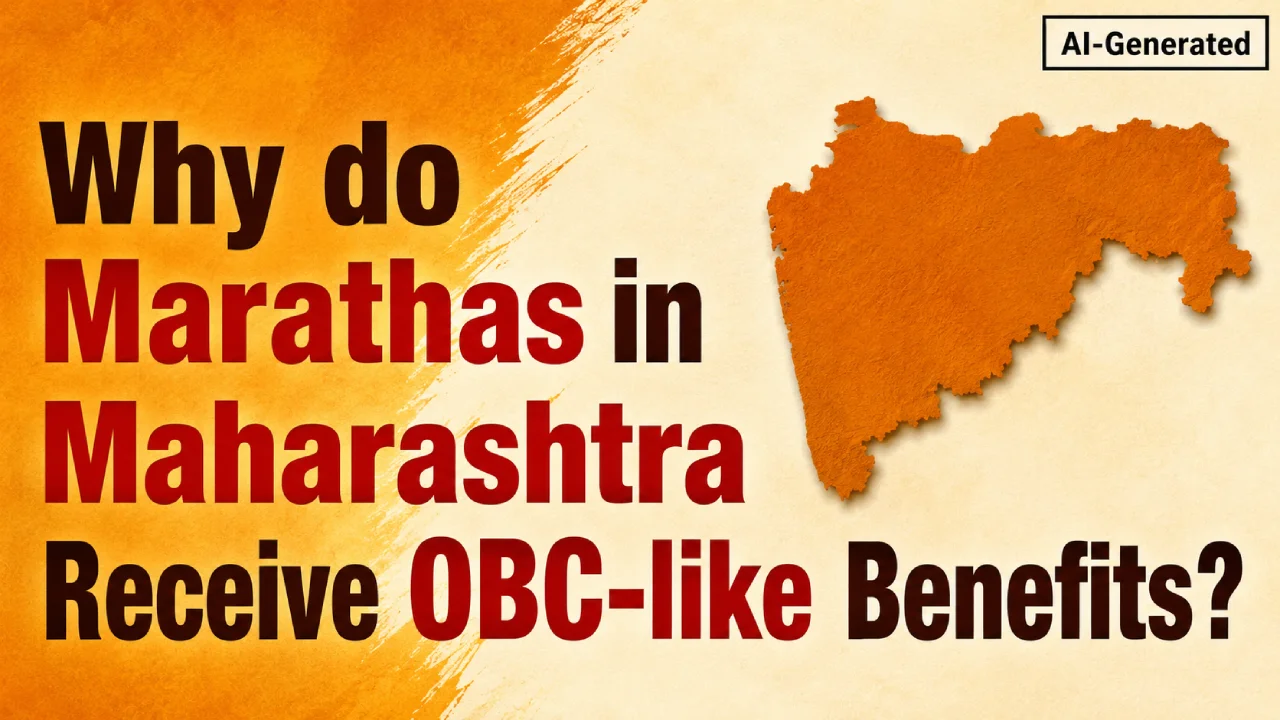
The Maharashtra government has recently announced the introduction of educational benefits and financial assistance for the Maratha community, honours that were previously reserved primarily for the Other Backwards Classes (OBC). This decision stops from the long-standing Maratha reservation movement and pressure used by Manoj Jarange, one of the movement's key figures.
The government maintains that this step aims to expand opportunities for students from economically disadvantaged Maratha families. However, the decision has also sparked a debate regarding social justice, constitutional principles, and government priorities.
For the past few years, Manoj Jarange has been leading a movement demanding reservations and various government benefits for the Maratha community. He began a hunger strike on May 30, 2026, and called it off late the following night after representatives from the Maharashtra government submitted a 12-point proposal.
Shortly thereafter, the state government announced that the Maratha community would be granted various educational benefits and financial assistance similar to those provided to OBC students. This announcement has sparked a fresh controversy.
A government announcement states that Maratha students will now receive various educational benefits previously applicable to OBC students. These include scholarships for Class 11 students, financial assistance for those at undergraduate and postgraduate levels, special benefits for students in professional courses, and support for students attending recognised professional institutions outside the state; furthermore, any new educational schemes introduced for OBC students in the future will also apply to Maratha students. The government has indicated that additional funds will be allocated to implement these schemes.
Over the past decade, substantial loans and financial assistance have been spent through the Annasaheb Patil Economic Development Corporation, established to foster the economic advancement of the Maratha community in Maharashtra.
Again, various researchers and social activists have pointed out that the allocations for organisations serving OBCs, Vimukta Jatis (Denotified Tribes), Nomadic Tribes, and Special Backwards Classes are comparatively much lower. Discussions regarding this disparity are gaining momentum as questions arise concerning the scale of allocations and benefits designated for a significant segment of the population.
The most significant aspect of this debate is the question of political influence. According to many observers, the Maratha movement has evolved into a powerful political pressure group over the past few years. The consistent raising of demands through the movement, coupled with the government's positive responses to them, has reinforced this perception.
Critics argue that when policy-making is driven by political pressure rather than social backwardness, the fundamental objective of social justice can be compromised.
The concepts of reservation and special provisions in the Indian Constitution were primarily designed to bring historically depressed and socially backward communities into the mainstream.
For this reason, many experts believe that before launching any new welfare scheme, the government must clearly vocalise its constitutional and policy-based rationale.
At the same time, they argue that the government's objective should be to empower the most sensitive sections of society, rather than only fulfilling the demands of politically important groups.


Comments ( 0)
Leave a Comment
No comments yet. Be the first to comment!