


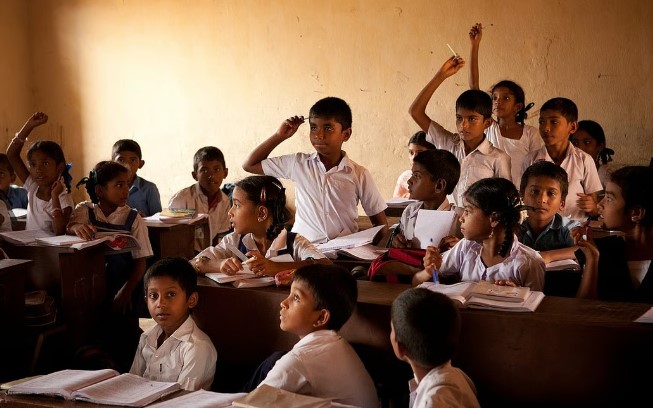
The Central Government has expressed serious concern regarding the current state of the school education system in Maharashtra. While approving the Annual Work Plan and Budget (AWP&B) for the 2026–27 financial year under the 'Samagra Shiksha' scheme, the Union Ministry of Education noted that many schools in the state still lack essential digital infrastructure, good teachers, and basic educational facilities.
Concerns have been further increased by the fact that, despite the introduction of subjects like Artificial Intelligence (AI) and coding, the majority of schools do not have ICT labs.
The Union Ministry of Education has approved a total budget of ₹2,494.17 crore for the 'Samagra Shiksha' scheme in Maharashtra for the 2026–27 academic year. These funds will be utilised through a joint partnership between the central and state governments. However, alongside the budget approval, the Centre has clearly said that the deficiencies identified in various areas must be addressed now.
A report by the Project Approval Board (PAB) reveals that out of 22,416 eligible upper primary, secondary, and higher secondary schools in the state, 21,009 still lack ICT labs. This means that approximately 97.12 per cent of eligible schools are without Information and Communication Technology labs.
Furthermore, 4,286 schools also lack smart classrooms. Despite the focus placed on AI, coding, and digital education, the Centre has termed this lack of necessary infrastructure a matter of serious concern.
The report also highlights several issues regarding teacher recruitment. Approximately 7,186 schools have only one teacher on staff. At the secondary level, about 17 per cent of teaching positions are vacant, while at the higher secondary level, the figure stands at around 25 per cent. The Centre has directed the state government to fill the vacancies now.
According to the Ministry of Education's observations, while enrollment at the pre-primary level is satisfactory, there is a need to further increase enrollment at the foundational, middle, and secondary levels.
Additionally, approximately 60 per cent of primary and upper primary schools have fewer than 30 students; instructions have been issued to examine the reasons for this and take necessary measures.
The report notes that there are no secondary schools within the prescribed distance in over 4,300 villages, and no access to higher secondary schools in more than 6,500 villages. The Centre has directed the state government to urgently address this situation.
According to the report, only 44.9 per cent of children aged 3 to 6 years have enrolled in Balvatika. Students with special needs account for just 1 per cent of total enrollments. Only 10.17 per cent of teachers have received training in inclusive education. The Centre has highlighted the need for rapid improvement in this area as well.
At a meeting of the Project Approval Board, Maharashtra's State Project Director reported that the installation of most of the approved ICT labs is currently underway and is expected to be completed by the end of the year. However, the Centre has directed that all digital and infrastructure projects be completed in 'mission mode' to ensure the necessary facilities are in place in government schools by the 2026–27 academic year.


Comments ( 0)
Leave a Comment
No comments yet. Be the first to comment!