
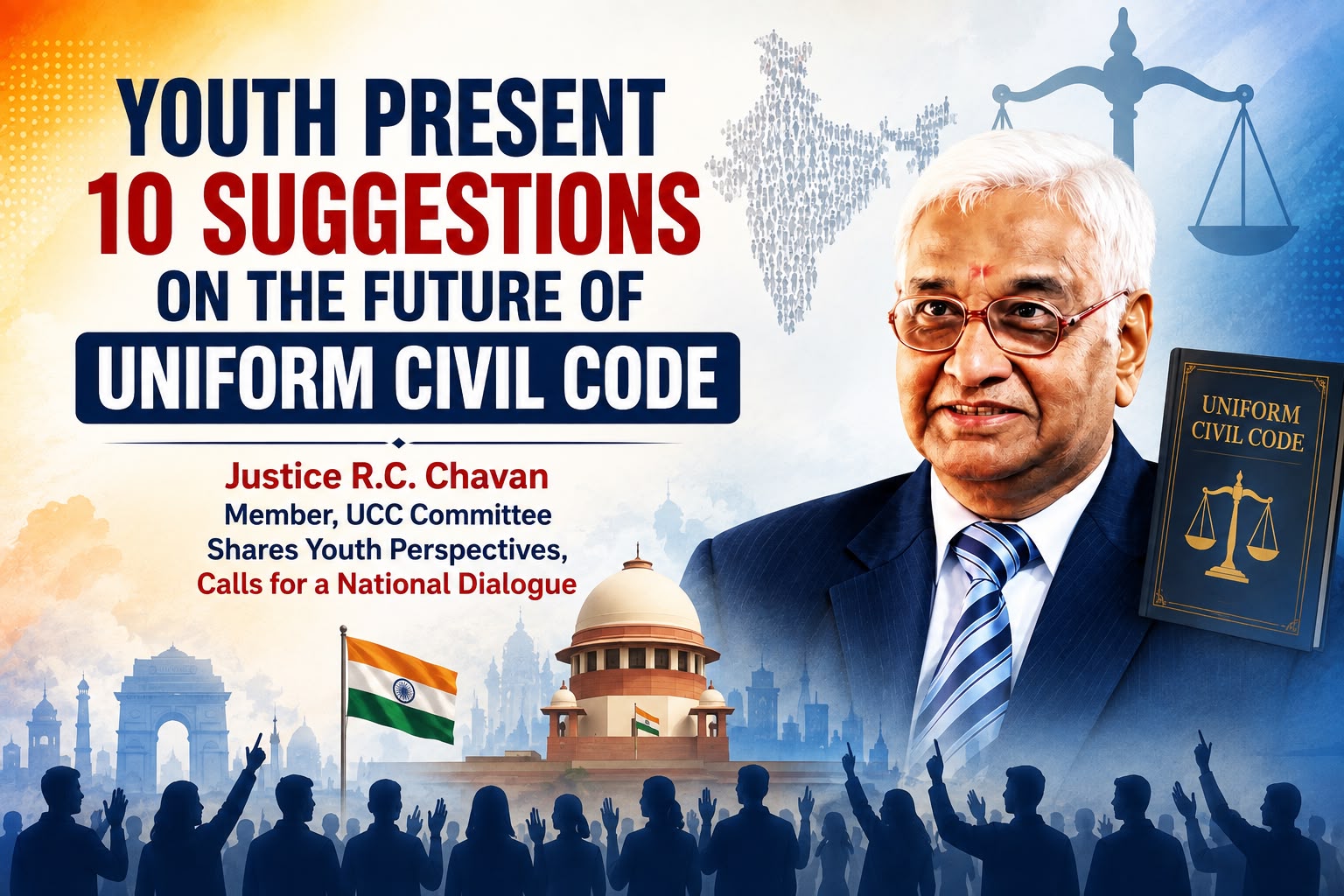
Nagpur: Amid ongoing nationwide discussions on the Uniform Civil Code (UCC), Justice R.C. Chouhan, a member of the UCC Committee, has made public ten key suggestions received from young people during various interactive sessions. According to him, these suggestions reflect how India’s youth envision the future evolution of the UCC.
Justice R.C. Chouhan clarified that these are not his personal views. Rather, they are ideas and suggestions shared by young participants during discussions, which he has presented solely to encourage wider public dialogue and thoughtful deliberation.
He stated that the increasing participation of young people in legal and social reforms is a positive sign for a democratic society. By bringing these perspectives into the public domain, he aims to encourage people from all sections of society to express their views on this important issue.
Ten Principles Suggested by Youth for the Future Development of the UCC
1. The UCC should aim to protect and strengthen the family as the fundamental unit of society, ensure its security, and promote a healthy genetic (DNA) legacy for future generations, thereby contributing to the development of a strong and healthy society.
2. A secure framework should be established to fulfill the human need for healthy and safe intimate relationships.
3. Intimate relationships between consenting adults should be accepted without social stigma. The nature and extent of social recognition for such relationships may be left to society’s discretion, but no relationship should be viewed with prejudice or disrespect.
4. The UCC should be completely gender-neutral. Instead of using terms such as “husband” and “wife,” it should use the term “spouses,” and instead of “son” and “daughter,” it should use “children.”
5. The UCC should be areligious (religion-neutral). It should not interfere with any religious traditions, while ensuring that religious practices remain within the private sphere.
6. Birth-based privileges in inheritance should be abolished, and all legal heirs should enjoy equal rights. Classifications such as Class I and Class II heirs should be eliminated.
7. Adults should have the freedom to determine the terms of their relationships through mutual agreement. Matters such as the duration of the relationship, separation or dissolution procedures, division of property, inheritance, responsibilities toward children, and obligations toward parents should be governed by legally enforceable agreements.
8. In addition to traditional religious marriage ceremonies such as Saptapadi, Nikahnama, or other customary rituals, couples should also be able to enter into legally binding agreements that clearly define responsibilities relating to separation, children, and elderly parents.
9. While respecting the Right to Privacy, a simple and voluntary system for registering intimate relationships should be introduced. It may also provide that partners in unregistered relationships would not be eligible for state assistance, compassionate appointments, insurance claims, or other welfare benefits. Such unregistered relationships should likewise not be recognized for inheritance purposes.
10. Every child should be considered legitimate, and biological or adoptive parents should be legally responsible for ensuring the child’s education and upbringing until the age of 18.
Suggestion Intended to Encourage Public Discussion
The suggestions cover several important themes, including family, equality, inheritance, privacy, gender neutrality, personal liberty, and children’s rights. While opinions on these issues may differ across society, Justice R.C. Chouhan emphasized that the purpose of sharing these suggestions is not to advocate any particular conclusion, but to ensure that the voices of young people become part of the broader public discourse.
He reiterated that these suggestions represent the views expressed by young participants during various discussions and should not be interpreted as his personal opinions. He also urged citizens to engage in informed, peaceful, and constructive dialogue on the subject.
Comments ( 0)
Leave a Comment
No comments yet. Be the first to comment!