
Gen Z Faces a New Reality of Relationships, Career Choices and Financial Pressure in the Digital Age
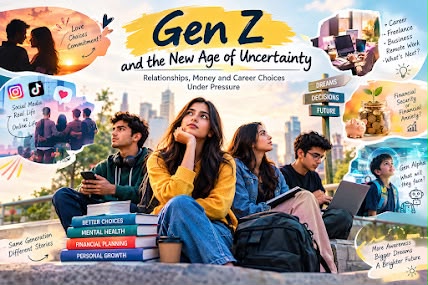
For today’s young generation, growing up has become a very different experience from that of previous generations. Social media, dating platforms, remote work, changing career opportunities and rising financial expectations have created a world where young people have more choices than ever—but also more questions about what they actually want.
Gen Z, broadly referring to people who grew up during the rise of smartphones and social media, has experienced a rapid transformation in the way people communicate, form relationships and plan their careers.
The result is a generation navigating opportunities and pressures that did not exist in the same form for earlier generations.
When relationships become a social expectation
Romantic relationships have always been part of young adulthood. What has changed is the constant visibility of other people’s relationships.
Social media feeds are filled with couples, romantic content, dating advice and carefully presented versions of personal lives. Films and online entertainment can also influence expectations about romance.
For some young people, this environment can create a sense that being in a relationship is something they are expected to achieve.
The question can gradually shift from “Am I ready for a relationship?” to “Why am I not in one?”
That distinction matters
A relationship involves more than simply having a boyfriend or girlfriend. Communication, mutual respect, emotional understanding, personal boundaries and commitment all play an important role.
At the same time, dating culture has introduced new terms such as situationships and casual relationships, reflecting the changing ways in which young people describe personal connections.
The wider challenge is not the existence of these relationships, but whether individuals clearly understand what they want from them.
More digital connections, but greater uncertainty
Dating applications and social media have expanded the number of people young adults can meet. They have also increased the number of choices available to them.
More choice can be useful, but it can also make decision-making more complicated.
The same pattern can be seen beyond relationship
Today’s young people can choose from traditional employment, entrepreneurship, freelancing, remote work, creative careers and a growing range of digital professions.
The career question is therefore no longer limited to finding a job.
For many young people, it is also about deciding which of many possible directions is worth pursuing.
The pressure to keep up financially
Financial security has emerged as another important concern for younger adults.
Income is only one part of financial wellbeing. Housing costs, lifestyle expectations, savings, education, family responsibilities and uncertainty about the future can all influence how secure someone feels.
Social media can add another layer to this pressure
A person may be satisfied with their own progress until they repeatedly see someone else’s new car, international holiday, expensive home or professional success online.
The comparison can create the impression that everyone else is moving faster.
But social media generally presents selected moments rather than an entire life. The financial struggles, uncertainty and setbacks behind those images are rarely visible.
This makes digital comparison an important part of the conversation surrounding financial anxiety among young people.
Career freedom has created a different kind of challenge
Previous generations often had fewer clearly defined career paths. Today’s young people can explore a much broader range of professions and working arrangements.
Freelancing and work-from-home opportunities have changed the traditional idea of employment. Digital platforms have also created new possibilities for people who want to work independently or build careers outside conventional workplaces.
However, flexibility also brings uncertainty.
When there are dozens of possible career paths, choosing one can become difficult. Young people may worry that selecting one path means missing a better opportunity elsewhere.
The challenge is therefore not simply finding opportunities.
It is developing the skills and confidence required to identify which opportunities actually fit an individual’s abilities, circumstances and long-term goals.
Is Gen Z a ''dumb generation''?
Describing an entire generation as “dumb” oversimplifies a much more complicated reality.
Every generation grows up under different social, economic and technological conditions.
Gen Z has had unprecedented access to information and communication. At the same time, it has had to navigate an online environment in which comparison, trends, advertising and personal identity frequently overlap.
The defining challenge may therefore be less about intelligence and more about clarity.
Young people have to decide which information deserves attention, which trends matter, which relationships are meaningful and which ambitions genuinely belong to them.
A generation learning to separate reality from the digital world
There is another side to the Gen Z story.
Many young people are increasingly aware that social media does not represent the complete reality of life.
They understand that followers do not necessarily represent achievement, that online popularity does not define personal worth and that another person’s carefully selected posts cannot provide a complete picture of their life.
This awareness can change the way technology is used.
Instead of allowing digital platforms to determine personal priorities, young people can use them for education, professional networking, creativity, communication and entertainment while maintaining boundaries between online content and real-life identity.
What will Gen Alpha learn from Gen Z?
The next generation, Gen Alpha, is growing up in an environment where smartphones, artificial intelligence, online education and digital entertainment are already normal parts of everyday life.
They are also growing up while watching Gen Z navigate the opportunities and problems created by the digital revolution.
That experience could give Gen Alpha an important advantage: the opportunity to learn from what came before.
The challenge will be to use technology without allowing technology to define every aspect of life.
That could mean understanding the difference between connection and dependence, ambition and comparison, financial planning and financial fear, and entertainment and reality.
The next generation will inherit more than technology
The debate surrounding Gen Z should not simply focus on whether young people are succeeding or failing.
A more useful question is what lessons can be carried forward.
Gen Z has grown up during one of the fastest periods of technological change in modern society. Its experiences provide an important opportunity to understand both the benefits and pressures of an increasingly connected world.
Gen Alpha will inherit that world
Whether the next generation handles it differently will depend not only on technology, but also on education, family guidance, financial awareness, emotional maturity and the ability to think independently.
The future may ultimately belong not to the generation with the most choices, followers or money, but to those who learn how to make thoughtful choices in a world offering more options than ever before.
For Gen Z, the challenge is understanding the world it has inherited.
For Gen Alpha, the challenge may be deciding what to change.

Comments ( 0)
Leave a Comment
No comments yet. Be the first to comment!