


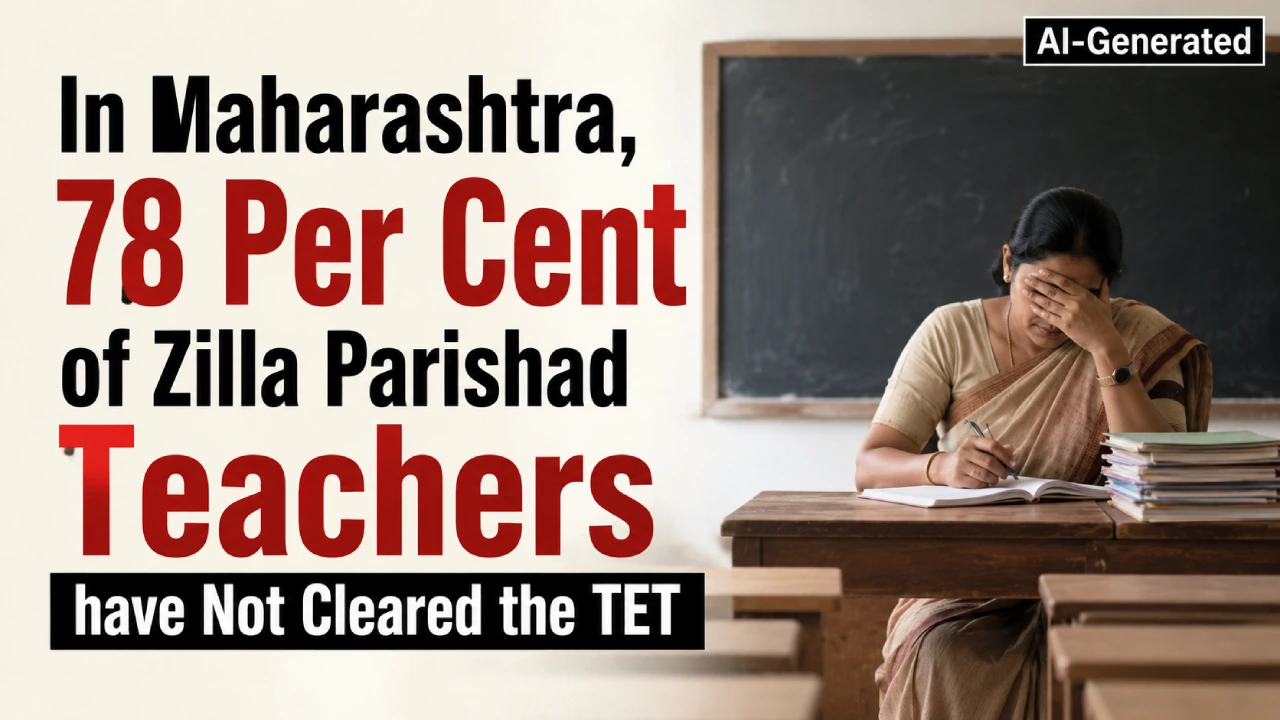
Significant information regarding Maharashtra's education system has come to light: approximately 78 per cent of teachers working in schools run by the state's Zilla Parishads have not yet cleared the Teachers Eligibility Test (TET), a qualification that is mandatory for school teachers under the Right to Education (RTE) Act, 2009.
Following a recent Supreme Court directive, these teachers have been granted a deadline of August 2028 to pass the TET. The state government has now initiated measures to raise awareness among teachers and has also taken steps to conduct the TET twice a year.
According to government data, there are a total of 1,87,389 sanctioned teacher posts across the 34 Zilla Parishads in Maharashtra. Of these, 1,75,155 teachers are currently employed; however, only 38,786 have acquired the TET qualification. In other words, only 22.14 per cent of the teachers have passed the TET, meaning approximately 78 per cent have yet to attain this mandatory qualification.
The Supreme Court recently delivered a significant verdict. The Court ruled that all serving teachers must qualify for the TET; this rule applies regardless of when they were appointed, and teachers have been granted time until August 2028 to accept. Several review petitions had previously been filed regarding this matter, but the Court dismissed them while providing some relief by extending the deadline.
Although the NCTE issued guidelines regarding the TET in 2011, its implementation did not take place simultaneously across various states. The first TET examination in Maharashtra was held in 2013; so, many teachers had already joined the service before the TET was introduced. This is exactly why a controversy has arisen over the matter.
According to government data, Palghar district leads the way, with over 35 per cent of teachers having qualified in the TET. At the other end of the range, the districts where the proportion of TET-qualified teachers is less than 9 per cent are Dhule, Gadchiroli, and Chandrapur. This disparity has come out as a major challenge for the state's education administration.
The state government has announced that it will further enhance awareness programs. Alongside this, the TET examination is being conducted twice a year, teachers are being encouraged to participate in the exam, and information is being spread at the district level. The government's goal is to have as many teachers as possible qualify for the TET by 2028.
Many teachers appointed from 2011 to 2011 or 2013 have expressed concern regarding this decision. They argue that the TET was not mandatory at the time of their recruitment, they joined service in compliance with the rules then in force, and that imposing a new condition retrospectively is unfair. However, according to the Supreme Court's verdict, the TET is mandatory for all currently employed teachers.
I am writing about this matter because the TET is not only an examination; rather, it is a crucial mechanism for ensuring the quality of primary and upper-primary education. The fact that such a large number of teachers have yet to attain this qualification raises a significant question regarding the education system. At the same time, it is essential to understand the potential impact of this situation on teachers, students, and the administration.


Comments ( 0)
Leave a Comment
No comments yet. Be the first to comment!