

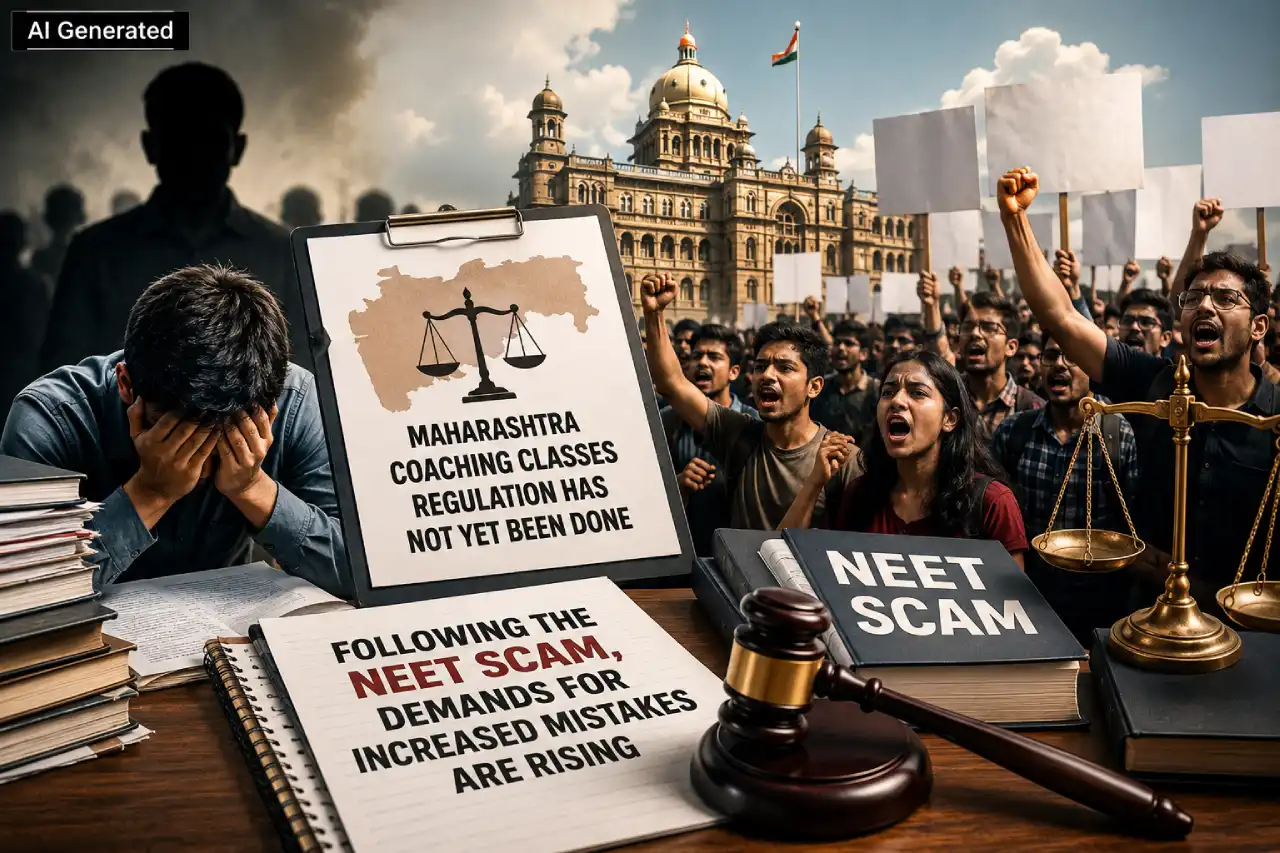
More than two decades have passed since the Bombay High Court issued its directive, yet no complete regulatory law governing private coaching classes has been implemented in Maharashtra. The issue has recently resurfaced in public discourse following the suggestion of several coaching centres in the controversy surrounding the NEET paper leak.
According to education experts, while the coaching industry in the state has expanded rapidly, the absence of an effective oversight mechanism is raising serious questions regarding accountability and transparency.
Currently, a growing number of students are becoming more trusting of coaching classes than of their schools or colleges. The private coaching system has grown to a massive scale, particularly in the area of preparation for medical and engineering entrance examinations. However, the continued lack of clear regulations for such a large educational ecosystem is charging growing anxiety among parents, students, and education experts alike.
Private coaching centers have now become a crucial component of the education sector. Millions of students, in particular, depend on coaching for their preparation for NEET, JEE, Board exams, and various competitive examinations. However, due to a lack of regulation, questions have long been raised regarding fee transparency, student safety, infrastructure quality, and misleading advertisements.
In 2000, an NGO led by Bhagwandas Rayani filed a petition in the Bombay High Court. They demanded that regulations be formulated for coaching institutes in Maharashtra, student protection be ensured, and accountability be introduced into the education system. Subsequently, the Court directed the State Government to frame rules to regulate coaching centers.
Following a court order, the Maharashtra government constituted a single-member committee. However, the draft rules appeared excessively strict to many coaching operators; disagreements arose regarding their execution, and the process stopped midway. The matter remained in a state of effective suspension for a prolonged period.
The issue of regulation has once again come to the lead following the recent emergence of several coaching centres' names in connection with the NEET UG paper leak controversy. Experts warn that a lack of oversight could lead to significant problems, compromise the integrity of examinations, and allow commercial pressures to effortlessly impact the education system. Therefore, demands for stricter monitoring have now gained considerable momentum.
The Maharashtra Class Owners Association has said that they are not opposed to regulation. However, they contend that the rules must be practical, take into account the realities of metro cities, and avoid overly strict infrastructure norms. In their view, requirements such as a mandatory library or a large designated area per student are not realistic.
According to sources within the School Education Department, checks on integrated classes may be boosted, and plans are underway to make biometric attendance mandatory. The objective is to control fake attendance, ensure classroom participation, and improve student monitoring.


Comments ( 0)
Leave a Comment
No comments yet. Be the first to comment!