


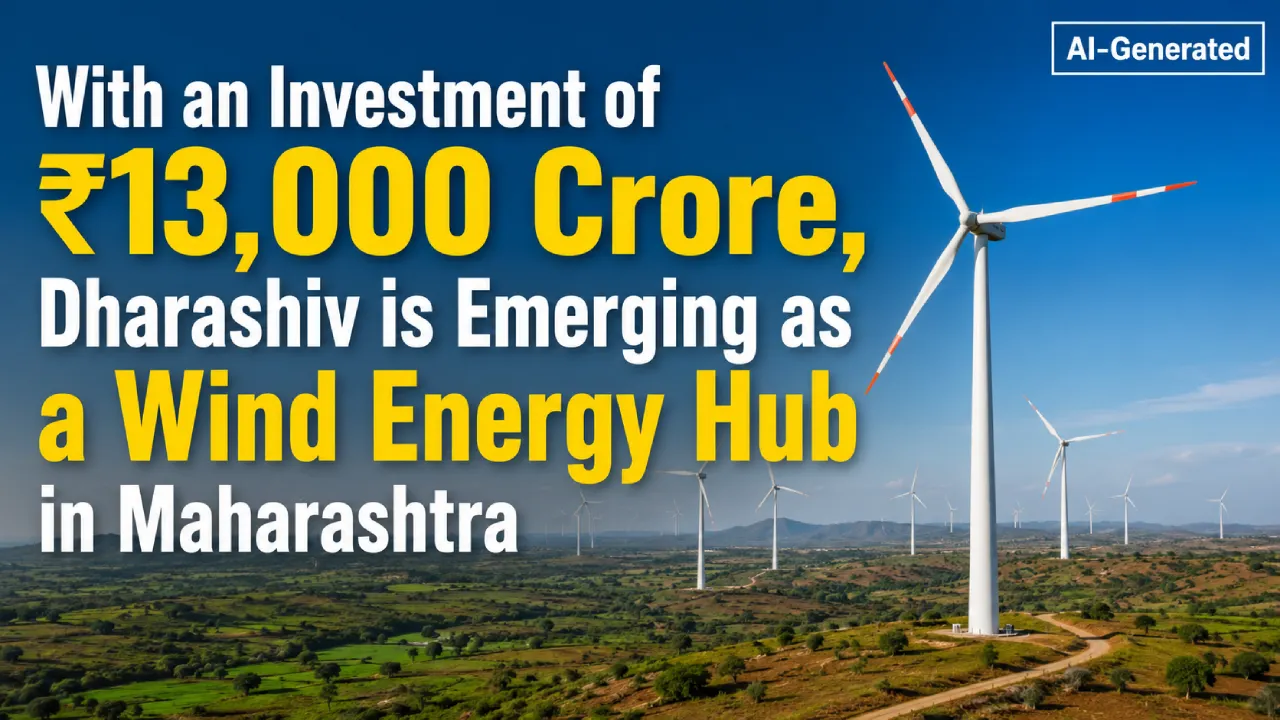
At one time, the Dharashiv district in Maharashtra's Marathwada region was primarily known for drought, water shortage, and the anxiety of farmers. However, the district's landscape has begun to change rapidly over the past few years. Driven by massive investments in the renewable energy sector, Dharashiv is now arising as a key wind energy hub in Maharashtra.
Hundreds of wind energy projects are being established across the district with investments from various private companies; these projects are not only generating electricity but also injecting new momentum into the local economy.
According to data from the Maharashtra Energy Development Agency (MEDA), a total of 495 wind power projects have been planned for Dharashiv district.
The combined generation capacity of these projects exceeds 2,179 megawatts. Of these, 242 projects with a total capacity of over 814 megawatts have been appointed in the last three years. The remaining projects are currently at various stages and are being executed gradually.
Investments of ₹13,000 crore have already been made in the wind energy sector of Dharashiv.
Various private companies are investing in these projects, and the investment volume is expected to rise further in the near future. Once all the projects are completed, a significant portion of Maharashtra's total wind energy generation will come from Dharashiv.
Dharashiv's geographical location and weather conditions are the district's greatest assets. Situated on the elevated terrain of the Deccan tableland, the district experiences steady wind currents for the majority of the year, conditions highly suitable for commercial wind power generation.
With relatively limited forest cover and vast tracts of uncultivated, rain-fed land, establishing large-scale wind farms has been feasible. In several areas of the district, wind power density exceeds 200 watts per square meter. According to experts, this level of wind power density is considered viable for wind energy projects.
The expansion of wind energy projects has created new employment opportunities for local people, particularly in areas such as construction, turbine installation, electrical infrastructure development, maintenance and repair, and transportation and logistics services. The growth of this sector is providing new job opportunities for many young men and women.
For a long time, Dharashiv's economy relied on agriculture. The agricultural sector frequently suffered losses due to a shortage of and scattered rainfall. However, the growth of the renewable energy sector is charting a new course for the district's economy. Today, Dharashiv is viewed not merely as an agricultural district but also as a key hub for green energy production in Maharashtra.
I am writing about this because the transformation of Dharashiv shows how proper planning and the effective use of natural resources can alter a district's destiny. Where an agricultural economy was once repeatedly battered by shortages, green energy has now opened the door to new possibilities.
This example of employment generation, investment, and long-term development driven by renewable energy can serve as an inspiration for other districts as well.


Comments ( 0)
Leave a Comment
No comments yet. Be the first to comment!